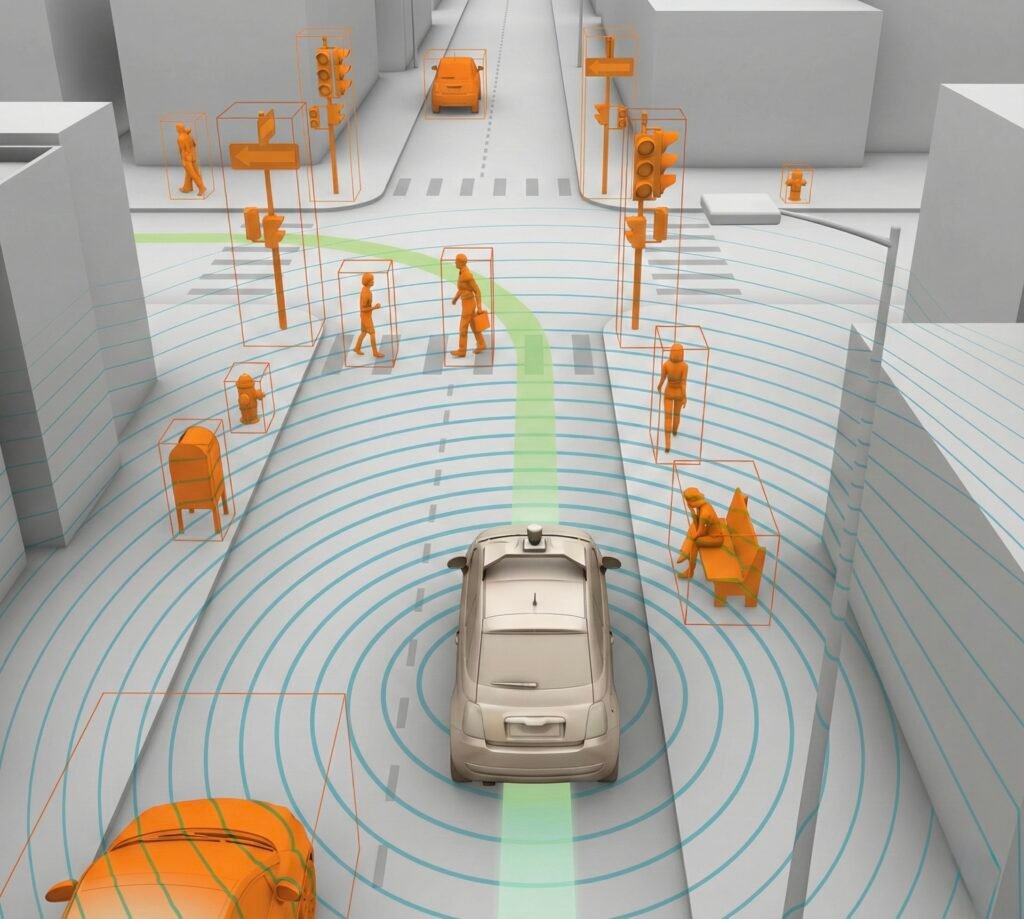
01 / Causal reasoning over real-world interactions
02 / Formal representation of physical concepts
03 / Versioned ontologies and assumptions
04 / Counded counterfactual analysis
We build infrastructure that allows technical teams to make explicit claims about what a system understands, what it does not understand, and what cannot be affirmed.
Safety-Critical Tooling
We design for:
01 / Post-incident auditability
02 / Reproducibility of conclusions
03 / Independence from training pipelines
04 / Compatibility with existing validation stacks
Our systems are designed for environments where failure is not just an engineering issue, but a legal, regulatory, and societal one.
Research-to-Production Continuity
That means:
01 / Integration paths that do not disrupt existing systems
02 / No dependence on speculative AI reasoning
03 / Explicit physical bounds
04 / Deterministic outputs
We focus on ideas that can survive contact with production constraints.
REALITY AUDIT INFRASTRUCTURE
[ RAI ]
Reality Audit Infrastructure is a safety-critical epistemic framework for autonomous systems.
[ RAI ] addresses a problem current stacks cannot solve:
When a system fails, can you prove whether it misunderstood the world, or merely encountered a rare case?
RAI is NOT:
✖︎ A simulator
✖︎ A perception dataset
✖︎ A synthetic data engine
✖︎ A replacement for fleet testing
RAI is:
✓ A causal audit layer
✓ A physics-grounded epistemic framework
✓ A system for quantifying and tracking understanding gaps
RAI Enables:
⇨ quantify epistemic debt
⇨ identify unknown-unknowns
⇨ trace failure lineage across time
⇨ produce defensible audit artifacts
⇨ support regulatory submissions with evidence rather than narrative
Development Status
[ RAI ] is under active development.
☑︎ The core epistemic framework, audit logic, and formalism are complete.
☐ The causal seed library is being constructed incrementally through controlled real-world capture and validation.